

 Tiếng Việt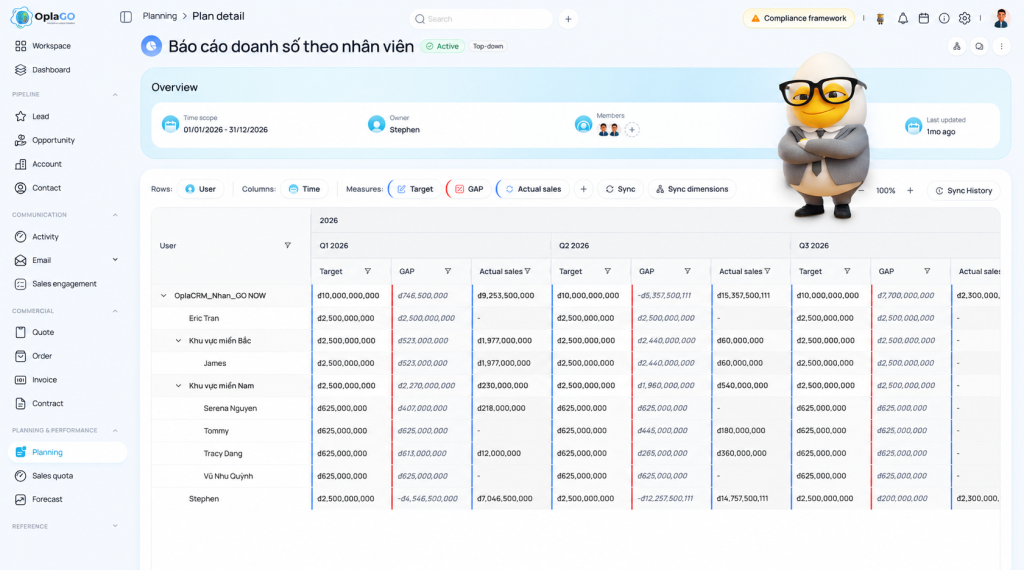
- Universal Sales Planningis a multi-dimensional approach to setting and tracking B2B sales targets across 5 dimensionssimultaneously — People,Time,Product,Territory,and Customer Segment — rather than the traditional 2D model of rep × time.
- 91% of B2B organizations missed quota in 2024. The root cause is rarely individual rep performance — it is the structural misalignment between targets and how B2B revenue is actually generated.
- McKinsey research shows that outperforming B2B companies realign sales priorities monthly,while typical companies still review annually. Universal Sales Planning is the operating model that makes monthly realignment possible.
- Excel breaks down at 4+dimensions.Universal Sales Planning becomes a structural requirement — not a preference — when an organization operates across multiple products,regions,and customer segments.
What is Universal Sales Planning?
Unlike traditional sales planning,which distributes a single quota number top-down through hierarchy and time period,Universal Sales Planning treats each dimension as an independent axis. The same total revenue target can be viewed from five different angles,pivoting between them without exporting reports or rebuilding spreadsheets.
“Single-dimension sales planning answers ‘who missed quota.’ Universal Sales Planning answers ‘which dimension is failing — and why.’ The first is reporting. The second is strategy.” — OplaCRM,Revenue Operations perspective
In B2B environments — particularly manufacturing,construction,distribution,and enterprise services — revenue is shaped by interactions between dimensions. A product line performs differently across regions. A customer segment behaves differently in different fiscal quarters. A territory has different demand profiles for different products. Traditional sales planning collapses these interactions into a single rep quota and loses the signal in the process.
Why Traditional Sales Planning Fails at Scale
In most B2B organizations,sales planning follows the same playbook:leadership sets an annual revenue target,the number is divided across departments,then across reps,then across months or quarters. This approach powered B2B sales for two decades — and still works for simple sales motions.
The model breaks when organizations cross specific complexity thresholds:multiple product lines,multiple regions,multiple customer segments,or sales cycles longer than 90 days. According to QuotaPath,91% of B2B organizations missed quota in 2024 — and RepVue’s analysis of 47,000+ sales reps found average quota attainment at just 43% in Q4 2024.
The data points to a systemic issue, not an effort issue. The Sales Collective’s 2026 research found that 35% of sales leaders attribute missed quota to “misaligned sales activities”— meaning effort directed at the wrong deals,segments,or products. Traditional sales planning makes this misalignment invisible until the period ends.
Four Failure Modes of Single-Dimension Planning
1 — Product mix gets ignored.When a rep carries a single quota number,they default to easiest-to-sell products. Strategic products that require longer education cycles get systematically underweighted. Leadership sees total revenue but loses visibility into portfolio balance.
2 — Geographic variance is masked.A $5M deal in a mature market is a different achievement than a $5M deal in a new market. Aggregate quotas obscure regional performance and lead to misdiagnosing market-level problems as people-level problems.
3 — Segment dynamics are flattened.Enterprise deals (9–18 month cycles,high ACV) and SME deals (1–3 month cycles,low ACV) require fundamentally different sales motions. When combined into one quota,reps gravitate toward whichever closes faster — distorting the customer portfolio over time.
4 — Root cause analysis becomes impossible.When the team misses 15% of quota,the obvious question is “why?” Traditional sales planning cannot answer it. Was it a regional issue? A product issue? A segment issue? The aggregated number collapses all variance into one figure.
The 5 Dimensions of Universal Sales Planning
Universal Sales Planning treats five dimensions as independent and simultaneously trackable axes. Each dimension reveals a different strategic question.
Dimension 1 — People &Hierarchy
The familiar dimension,but with structural depth:company → division → region → team → individual rep. Universal Sales Planning preserves the full hierarchy so revenue can be analyzed at every level without re-aggregation.
A Regional Sales Manager sees their region’s pipeline. A Sales Director sees all regions. A CEO sees the company total. Same dataset, three views, no data export.
Dimension 2 — Time & Seasonality
Beyond month and quarter — Universal Sales Planning captures fiscal year, customer budget cycles, and industry seasonality. In construction, manufacturing, and agriculture, 60–70% of annual revenue may concentrate in specific quarters. A planning system that does not reflect this generates unrealistic monthly quotas — and creates artificial “underperformers” and “stars” based on luck of calendar.
Dimension 3 — Product & Portfolio
Each product carries different margin, complexity, and strategic role. A cash-cow line with high volume but low margin plays a different strategic role than a new product launch with high margin but unproven market.
Without product as a planning dimension, sales reps receive no signal about which products to prioritize. Portfolio balance becomes incidental rather than intentional.
Dimension 4 — Geography & Territory
Territory is not just a coverage assignment — it is a demand variance dimension. The same product can have 2–3x differences in conversion rate, average contract value, and sales cycle length across regions due to market maturity, competitive intensity, and industry concentration.
Tracking territory as an independent dimension separates “people problems” (specific rep underperforming) from “market problems” (entire region under pressure) — two situations requiring completely different interventions.
Dimension 5 — Customer Segment
Enterprise, SME, Government, or industry vertical. This is the dimension with the largest effect on sales unit economics. A $200K Enterprise deal involves a 6–13 person buying committee, 9–18 month cycle, and complex procurement process — fundamentally different from a $5K SME deal.
When segments are not separated in planning, the easier segment dominates by default. Strategic intent to penetrate Enterprise — or hold position in Government — gets diluted through everyday decisions.
Universal Sales Planning vs Territory Management vs S&OP
These three concepts are frequently confused. Each addresses different aspects of revenue planning.
| Framework | Primary axis | Purpose | Update frequency | Best for | Reveals root cause? |
|---|---|---|---|---|---|
| Traditional Sales Planning | Rep × Time | Quota distribution | Quarterly / annually | Simple sales orgs | No |
| S&OP | Demand × Supply | Supply-demand balance | Monthly | Manufacturing | Partial |
| Territory Management | Geography | Sales coverage | Annually | Field sales | No |
| Universal Sales Planning | People × Time × Product × Geo × Segment | Strategic execution at scale | Monthly to real-time | Complex B2B, multi-product | Yes |
Universal Sales Planning does not replace these frameworks — it layers above them. S&OP continues to balance supply and demand. Territory Management continues to assign account coverage. Universal Sales Planning manages strategic execution across all dimensions simultaneously.
Universal Sales Planning in OplaCRM
OplaCRM implements Universal Sales Planning as a dedicated module within the Planning & Performance workspace. Plans are structured as hierarchical trees — the company total cascades down to regions, then teams, then individual reps — with each cell showing Target, Actual Sales, and GAP in real time.
Hierarchical, Multi-Dimensional Configuration
Plans support rows by User (or any hierarchy level) and columns by Time (quarter, month, or fiscal year). Additional dimensions — Product, Territory, Segment — can be added as filters or as additional row/column axes. The structure adapts to the business, not the other way around.
Real-Time GAP Calculation
When a deal closes in the CRM pipeline, the Actual Sales figure updates immediately at every relevant intersection — by rep, by region, by product, by segment. The GAP column shifts color from red to green automatically. There is no end-of-month aggregation delay.
Top-Down or Bottom-Up
OplaCRM supports both planning approaches. Top-down: leadership sets the company total and distributes across dimensions based on strategic priority. Bottom-up: each rep submits their projected achievement and the system aggregates up the hierarchy. Mature organizations typically use both — top-down for strategic constraint, bottom-up for execution feasibility validation.
Note from OplaCRM: The 5-dimension framework — People, Time, Product, Territory, Segment — is the default starting point. Organizations can add, remove, or rename dimensions to match their specific business model. A holding company might add a Subsidiary dimension. A SaaS company might add a Product Tier dimension. The framework is opinionated, but the structure is configurable.
From Excel to Universal Planning — A Practical Migration
Most B2B teams arrive at Universal Sales Planning the same way: they start with Excel, scale until Excel breaks, then look for alternatives. Understanding the migration path matters because it explains when the transition becomes necessary — not optional.
Where Excel Still Works
Excel is a viable Universal Sales Planning tool for organizations with:
- 2–3 active dimensions (typically People × Time × one of: Product, Territory, or Segment)
- Fewer than 20 sales reps
- Annual replan cycle (no need for monthly pivots)
- Single owner of the workbook (no concurrent editing)
A well-structured Excel workbook with named ranges and clean tables can handle this scope effectively for years.
Where Excel Breaks
The breakdown typically happens at one of three thresholds:
Four or more dimensions. A 2D spreadsheet cannot natively represent four independent axes. Teams resort to multi-sheet workbooks (one per product), nested pivot tables, or concatenated keys — all of which create maintenance burden and version control issues.
Monthly or weekly replanning cadence. When the plan needs to update with each pipeline change, manual recalculation becomes unsustainable. The plan starts to lag behind reality, and decisions are made from stale data.
Multiple stakeholders editing concurrently. When Sales Ops, Regional Managers, and Product teams all need to update the plan, version conflicts emerge. The “single source of truth” fragments into five copies on five laptops.
The Migration Path
A practical transition follows three stages:
Stage 1 — Audit existing dimensions. Most B2B companies already operate with 4–5 implicit dimensions but track only 2. Document which dimensions actually drive variance in your revenue.
Stage 2 — Establish baseline. Pull 4–8 quarters of historical data segmented by each dimension. This baseline determines realistic distribution ratios for the new plan.
Stage 3 — Implement on a purpose-built platform. Universal Sales Planning modules — like the one in OplaCRM — are designed specifically for multi-dimensional sales plans with real-time pipeline sync, hierarchical view, and built-in pivot logic. The migration from Excel is typically 4–8 weeks for mid-market B2B organizations.
When NOT to Use Universal Sales Planning
Universal Sales Planning is a maturity progression, not a universal best practice. Avoid it in these situations:
- Single product, single market, single segment businesses. Two-dimensional planning is sufficient, and Universal Sales Planning only adds overhead.
- Transactional sales motions under 30-day cycles. Feedback loops are already fast enough that root cause diagnosis happens naturally.
- Teams below 10 reps. Complexity overhead exceeds strategic value at this scale.
- Organizations without baseline data hygiene. Universal Sales Planning on top of dirty CRM data produces dirty multi-dimensional output. Fix the foundation first.
3 Warning Signs Your Sales Plan Is Single-Dimension
1 — You can answer “who missed quota” but not “which segment missed.” If your monthly review identifies underperforming reps but cannot identify whether Enterprise, SME, or Government drove the miss, your planning is one-dimensional. Diagnosis depth is the clearest signal.
2 — Strategic priorities exist on a slide but not in any rep’s quota.If leadership says “this year we focus on Enterprise” but no individual quota reflects an Enterprise sub-target,the priority will get diluted through execution. Strategy must appear in the numbers,not just the narrative.
3 — Your quarterly replan takes more than two weeks of Sales Ops time.If updating the plan requires multiple rounds of spreadsheet consolidation,the plan is stale before it ships. Teams that win update plans monthly with no consolidation lag — structurally impossible in Excel beyond 3 dimensions.
Universal Sales Planning Self-Assessment — 5 Questions
1 — How many active dimensions does your business actually have?List your real dimensions:people,time,product lines,territories,customer segments,channels. Most B2B companies have 4–5. Tracking only 2 in your sales plan means hiding the other 3.
2 — Can your Sales Director answer “which dimension missed” within 60 seconds?If diagnosing a miss requires Sales Ops to run a custom query,your planning system cannot support monthly realignment. McKinsey research shows monthly cadence is the floor for outperforming B2B organizations.
3 — Where does your sales quota actually live?If quota lives in a manager’s email or a static spreadsheet, GAP calculations are manual and stale. Quota must live in the same system as pipeline data for real-time GAP visibility.
4 — How does strategic priority enter individual quotas? If your CEO’s strategic focus on a specific product or segment is not visible in any rep’s quota, the priority will not survive execution. Universal Sales Planning embeds priority directly into the target structure.
5 — Does your CEO see plan vs actual without waiting for a report? If reporting takes longer than one day, every important decision is delayed by a week. Real-time visibility is not a luxury — it is the precondition for monthly strategic realignment.
Frequently Asked Questions
What is Universal Sales Planning?

Universal Sales Planning is a B2B sales planning method that allocates revenue targets across multiple dimensions simultaneously — typically People, Time, Product, Territory, and Customer Segment. Unlike traditional sales planning, which distributes a single quota through hierarchy and time, Universal Sales Planning treats each dimension as an independent axis with its own visibility and accountability.
How is Universal Sales Planning different from Territory Management?
Territory Management addresses only the geographic dimension — who covers which region. Universal Sales Planning addresses geography along with four other dimensions (People, Time, Product, Customer Segment). Territory Management is a subset of Universal Sales Planning, not an alternative to it.
Do you need a CRM platform to do Universal Sales Planning?
For organizations with 2–3 dimensions and fewer than 20 reps, a well-structured Excel workbook can suffice. For 4+ dimensions, real-time pipeline sync, or monthly replan cycles, a purpose-built Universal Sales Planning module — such as the one in OplaCRM — becomes a structural requirement due to the limitations of 2D spreadsheets.
How often should Universal Sales Plans be reviewed?
Monthly at minimum for B2B organizations. McKinsey research shows that outperforming B2B companies update account priorities and resource allocation monthly, while typical companies review annually. The cadence gap drives a significant performance gap.
What is the difference between top-down and bottom-up Universal Sales Planning?
Top-down: leadership sets the company total and distributes it across dimensions based on strategic priority. Bottom-up: each rep submits their projected achievement and the system aggregates up the hierarchy. Mature organizations use both — top-down for strategic constraint, bottom-up for execution feasibility validation.
Can Universal Sales Planning work with my existing forecasting process?
Yes — Universal Sales Planning and sales forecasting serve different purposes and complement each other. Planning sets the target structure across dimensions. Forecasting estimates actual close likelihood within that structure. Both run in parallel within OplaCRM, with the forecast surfacing against the multi-dimensional plan automatically.
See OplaCRM Universal Planning with your team’s actual sales structure
No fixed demo script. Just a conversation about how your sales organization operates today,and whether Universal Sales Planning would actually solve the problem you are facing.
No pressure. No hard sell. Just a real conversation about your sales process.