

 Tiếng Việt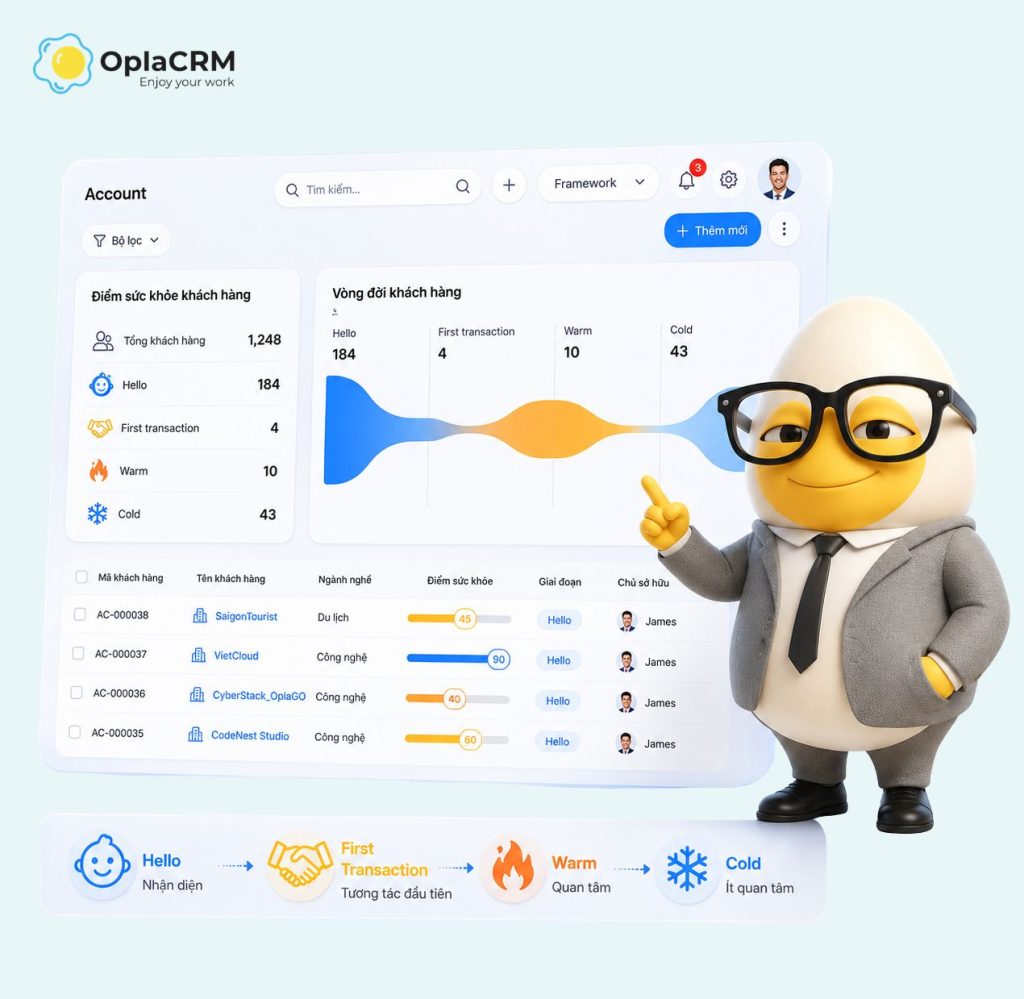
Account Health Score is a composite metric measuring the “health” of the relationship between a business and each individual B2B customer. The concept originated in international SaaS platforms (Gainsight, Salesforce, HubSpot) as a tool to help Sales and Customer Success teams detect early churn risk, rather than only reacting after a customer has already left.
OplaCRM brings this concept to the Vietnamese B2B market with its own approach: calculated automatically from real interaction data – no surveys, no manual entry by Sales reps – and classified visually into 3 color levels: Green (healthy), Yellow (needs attention), Red (high risk).
★ Key Takeaways
- B2B Sales Managers often ask the wrong question every morning – Account Health Score helps answer the right one: “Who should I focus on today?”
- 24% of B2B businesses lose customers every year; a 5% increase in retention can grow profits 25-95% (Reichheld & Sasser, Harvard).
- OplaCRM calculates Account Health Score in 2 layers: Contact Health Score (per contact) → AI aggregates into Account Health Score weighted by buying role.
- Unlike systems that count activity volume, OplaCRM scores by Outcome (Negative/Neutral/Positive) – making it impossible to game with hollow activity logging.
- Health Score only has value as an input for action, not a KPI to report on. The biggest trap is turning the Green rate into a team target.
◷ In this article
- The wrong question that wastes your Sales team’s time
- Why B2B Customer Churn Rate almost always happens in silence
- What is Account Health Score?
- What Account Health Score is NOT
- How OplaCRM calculates it:from Contact to Account
- Customer lifecycle:Hello → First → Warm → Cold
- Account Health Score in the real daily workflow
- How to implement it correctly – 4 steps
- 3 common traps to avoid
- Frequently asked questions
1. The wrong question that wastes your Sales team’s time
Every morning, a Sales rep opens the CRM to hundreds of customers. The question they typically ask is “which customer is the most valuable?” – and they spend most of their time on the big names in the list. This is a natural reflex: large account = large revenue = high priority. That logic is correct – but it is not enough.
The question that actually matters is: “Who should I focus on today?”
The two questions sound similar, but they lead to completely different actions. The most valuable customer is sometimes perfectly stable – they have regular deals, good engagement, and need no intervention this week. Meanwhile, a mid-tier customer is gradually going cold, with signals appearing for weeks that nobody noticed because they were not in the top priority list.
The consequences of this flawed approach do not show up immediately. They play out quietly over 2-3 quarters: revenue holds because the large accounts are still there, but retention of important mid-tier customers quietly declines. By the time the year-end report shows an unusually high churn rate, the Sales Manager finally realizes – and by then, the list of customers who have already left is too long to recover.
Account Health Score was built to answer that second question correctly. Instead of ranking customers by past value, it ranks by current level of need for attention – a completely different lens on the same familiar list every morning.
2. Why B2B Customer Churn Rate almost always happens in silence
Unlike B2C – where a customer can leave abruptly after a single bad experience – B2B churn is almost always a prolonged process. Customers do not complain, do not send emails asking for explanations, do not post negative reviews. They simply stop responding.
This process typically follows a recognizable pattern. First, email replies slow down – from 2 hours to 1 day, then 3 days. Next, meetings get postponed with vague reasons. Then, the decision-maker stops appearing in conversations – only end-users and lower-level staff remain. Finally, the gap between interactions stretches until there is nothing left.
The biggest problem is not the absence of signals – it is that those signals do not live on a single screen:
- Slowing email replies – sitting in Sales A’s inbox
- Meetings rescheduled repeatedly – sitting in Sales B’s calendar
- Comments about a competitor – existing only in Sales C’s head after last week’s meeting
- The customer’s new approver has not been introduced to the team – only Sales D knows
Each piece, standing alone, looks normal. There are plenty of reasonable explanations for each signal – they are busy, it is year-end, the contact is traveling. But put together, they form a clear picture of a customer who is leaving. By the time the Sales Manager sees that picture, it is usually too late to reverse the situation. This is the most silent form of revenue leakage in B2B– revenue does not evaporate through a clearly lost deal (with a buyer, a price, a win/loss reason),but through old customers leaving without a word. And it is the hardest type of loss to identify in a report:because there is no moment of truth to mark, no specific deal to analyze. Just a gap that quietly grows in the customer base.
3. What is Account Health Score?
Account Health Score is a composite metric reflecting the actual state of the relationship between a business and each individual customer.It is calculated automatically, continuously, from real interaction data – no surveys, no manual entry by Sales reps. Think of Health Score like the heart rate on a smartwatch – but instead of measuring your body,it measures the state of a relationship. It is not a mysterious number, not a prediction of the future, simply a synthesis of behavioral signals that already exist but are scattered everywhere, turned into a single metric with actionable meaning. Results are displayed as 3 clear color levels, so Sales can look and immediately know what to do:
Relationship is stable with positive momentum. Regular engagement, open opportunities or a recently completed deal. Action: Maintain, look for expansion opportunities (upsell, cross-sell).
Signs of slowing down. Interaction frequency dropping, responses slower than baseline, or decision-maker less present. Action:Sales rep proactively re-engages within 48 hours.
Relationship is clearly declining. No meaningful activity for an extended period, or warning signals (such as customer asking about competitors). Action:Sales Manager intervenes directly, builds a re-engagement plan.
In OplaCRM, Account Health Score is displayed directly next to each customer name in the Account list – Sales Managers scan the full list and immediately see who needs attention today. No separate reports to run, no meetings needed to ask.
4. What Account Health Score is NOT
The definition is straightforward. But equally important – and where most teams go wrong – is understanding what Account Health Score is not. This is what causes the majority of Health Score projects in B2B companies to fail:
Not a KPI to optimize for a pretty dashboard
When the Green rate becomes the team’s target, Sales reps will optimize for color – not for the actual relationship. They will find ways to mark accounts as Green, log hollow activities to maintain the score, and avoid honest Outcome assessments out of fear of affecting their rating. The result: a beautiful dashboard, but the real signals have been distorted.
Not a measure of Sales rep performance
An account turning Red does not mean that Sales rep is underperforming. There are many factors outside their control: the customer’s natural cycle,a competitor just reached out,internal issues on the customer’s side, a change in decision-maker. Evaluating Sales reps based on Health Score color will create a culture of concealment – and will sooner or later render the system useless.
Not a number to report upward
Health Score is a daily action support tool – placed next to a customer name, used in the weekly pipeline review. It is not a month-end metric to send to the CEO. When Health Score appears in executive reports, it tends to be misinterpreted and loses its meaning.
“When a measure becomes a target, it ceases to be a good measure.” – Goodhart’s Law, applied directly to CRM.
Health Score is only genuinely useful when it serves as an input for decisions, not an output for reporting. This small distinction determines the entire success or failure of a Health Score initiative in any organization.
5. How OplaCRM calculates it: from Contact to Account
Most Health Score systems on the market calculate scores based on activity volume:how many emails were sent, how many calls were made, how many meetings were held. This is the easiest method to build – but also the easiest to game. The problem is obvious:a Sales rep can log 10 thirty-second calls to keep the score looking good. Or blast bulk emails with no real content. The numbers look fine, but the actual value is zero. A volume-counting system cannot distinguish between one meaningful 5-minute call and ten meaningless 30-second ones. OplaCRM takes a completely different approach – starting from interaction quality at the individual contact level,through 2 layers of calculation:
Layer 1:Contact Health Score
Every contact within an Account has its own Health Score. This is the core differentiator: OplaCRM does not calculate a single number for the whole company, but for each individual person within that company. Contact Health Score is based on 2 factors:Interaction quality (Outcome).Each time a Sales rep completes an activity with a customer – meeting, call, email, or message – the system requires an Outcome assessment: Negative, Neutral or Positive. This is a mandatory field. Without an assessment, the activity is not counted as complete. This principle makes gaming through hollow activities difficult:if a Sales rep marks everything as Positive, the system will detect the abnormal pattern and flag it. Frequency and recency.Older signals fade over time. A Positive call from 6 months ago carries far less weight than a Neutral call from last week. Health Score reflects the “recent temperature” of the relationship, not the accumulated history. This is an important point – it prevents the “resting on past glory” problem:a long-standing VIP customer with a beautiful interaction history, but with no meaningful activity in the past 3 months.
Layer 2:AI aggregates into Account Health Score
From all the Contact Health Scores within an Account,AI aggregates them into an Account Health Score weighted by buying role:
| Buying Role | Weight | Real-world examples |
|---|---|---|
| Decision Maker | Highest | CEO, Director, contract signatory |
| Approver | High | CFO,Finance Manager, budget approver |
| Influencer | Medium | Technical lead, external consultant |
| User | Lower | Staff who directly use the product |
This principle has very practical implications:not every contact carries equal weight. An account may look healthy because Sales is doing great with end-users – consistent interactions, fast responses, lots of Positive notes – but is cold with the decision-maker(no meeting in 3 months, no meaningful email exchange). In this case,the AI still flags it as a risky account. Because ultimately, the decision to renew or leave belongs to the decision-maker – not the end-user. This is one of the reasons Sales teams are sometimes surprised to see an account that “looks great” rated as Yellow. But that is exactly the value of Health Score:it sees what human intuition tends to overlook.
6. Customer lifecycle:Hello → First → Warm → Cold
Alongside Health Score, OplaCRM automatically classifies Accounts by relationship lifecycle – adding another dimension of context:
Customer has no closed project yet. In the early stage of getting acquainted, exploring needs.
Customer has completed their first project. A critical stage for building trust and expanding the relationship.
Customer has more than 2 projects. A returning client with a proven working relationship.
Customer has not returned in a long time. May be in a natural pause – or may have quietly left without being detected.
The combination of Health Score (relationship health) and lifecycle stage (relationship phase) gives Sales Managers a two-dimensional picture that is far more valuable than either metric alone. The clearest example:a Warm customer with a Red Health Score is the most dangerous signal. They are an established customer – multiple projects, an invested relationship – but they are drifting away. This is typically the kind of customer who can still be recovered if caught early, because they still remember the value you delivered. In contrast, a Hello customer with a Yellow Health Score does not require major alarm – they are still in the exploration stage, with no commitment yet to lose. The two dimensions are displayed side by side in OplaCRM, helping Sales Managers distinguish between “customers who need rescuing” and “customers who need nurturing” – two completely different types of action.
7. Account Health Score in the real daily workflow
Health Score only creates value when it appears at the right moment, in the right context. If it lives in a reporting tab that Sales has to remember to open, it will never get used. In OplaCRM, Health Score is embedded into 3 key touch points in the daily workflow:
In the Account list view
The health score is displayed directly next to each customer name, alongside their lifecycle status. When the Sales Manager opens the Account page in the morning, no separate report needs to be run – the full list appears with Green/Yellow/Red colors clearly visible. Filter by color to see only the accounts that need attention today. Sort by Health Score descending to view the reddest accounts first. All of this happens in seconds.
In the Account detail page (Account 360)
When clicking into a specific account, all signals converge onto a single screen:full interaction history(each interaction with its assessed Outcome),open opportunities with AI-calculated win probability, orders and invoices, and the customer org chart with each person’s buying role clearly marked. A Sales rep enters one screen and has all the context needed to decide the next step – no need to ask colleagues, no need to dig through old emails.
This is especially important during rep handovers, or when a Sales Manager needs to urgently intervene on a Red account. Instead of spending half a day catching up on history, everything is already synthesized and ready.
In the management dashboard
At the Sales Manager level, the dashboard allows filtering the full customer list by Health Score color, combined with other filters (region, industry, deal size). Under 5 minutes each morning to know where intervention is needed today, and to assign specific actions to the right people. This is the difference between managing based on end-of-week reports (slow reaction) and managing based on real-time signals (proactive).
8. How to implement it correctly – 4 steps
Technology is only half the equation. The other half – and often the harder half – is process and team culture. Below are 4 implementation steps validated across dozens of real deployments:
Step 1 – Map buying roles before go-live
Health Score is only accurate when the system knows who the decision-maker is in each account. Before going live, Sales reps need to update buying roles for key accounts: Decision Maker, Approver, Influencer, User. This is a one-time investment that affects the accuracy of the entire system going forward.
In practice, this step is frequently skipped or done carelessly – and that is the primary reason Health Score “looks wrong.” When the system does not know who the decision-maker is, it will weight all contacts equally, leading to skewed assessments. Investing 1-2 weeks for Sales reps to update buying roles for the 50-100 most important accounts will pay back in dramatically improved accuracy over time.
Step 2 – Build a culture of honest Outcome logging
The score is only as good as the data going in. More important than logging enough quantity is logging honestly. A call that ended with the customer deflecting must be logged as Negative, not Neutral. A meeting the customer postponed twice must be reflected accurately, not “beautified.”
This is a culture issue, not a technical one. Sales Managers need to create an environment where honest Outcomes are encouraged, not used to judge individual performance. If Sales reps feel that logging Negative will hurt their KPIs, they will avoid it – and the entire system loses its value. Best practice: clearly separate “interaction assessment” (for Health Score purposes) from “performance evaluation” (using separate metrics).
Step 3 – Build a color-based action playbook
Without predefined actions, Health Score is just a number that leads nowhere. Before go-live, the team needs to align on:
- When an account turns Yellow: Sales rep reaches out within 48 hours, with the specific goal of reconnecting with the decision-maker. Schedule 1 meeting within the next 2 weeks.
- When an account turns Red: Sales Manager directly steps in. Build a re-engagement plan with a clear timeline (typically 30 days), a specific owner, and measurable milestones.
The playbook does not need to be complex – it just needs to be clear. The goal is that when a Sales rep sees an account change color, they immediately know what to do in the next 5 minutes, rather than wondering “so what should I actually do here?”
Step 4 – Bring Health Score into the weekly pipeline review
Not the monthly report. Weekly. Review accounts that changed color during the week – this is the best coaching opportunity for Sales Managers: why did this account shift from Green to Yellow? What happened in the most recent interaction? What support does the Sales rep need? Does this need to be escalated?
This conversation is worth far more than any skill-based training session – because it teaches Sales reps how to read signals from their actual accounts, not from hypothetical case studies. After 3-6 months of working with Health Score this way, the Sales team will develop a “sixth sense” about customer health – and that is the most lasting long-term asset Health Score creates, beyond the tool itself.
9. 3 common traps to avoid when implementing Health Score
Health Score is a powerful tool, but it is also easy to implement incorrectly. Below are the 3 most common traps – and how to avoid them:
| Trap | Symptom | How to avoid |
|---|---|---|
| 1. Making the Green rate a team KPI | Sales reps optimize for dashboard color, log hollow activities to maintain score, avoid honest Negative assessments out of fear it will affect their performance review. | Health Score is a decision-support tool, not a performance evaluation metric. Clearly separate “decision-making tool” from “people evaluation tool.” |
| 2. Measuring by quantity instead of quality | The system counts 10 thirty-second calls the same as 1 meaningful five-minute call. Score looks good but means nothing. | Require Outcome assessment (Negative/Neutral/Positive) for every activity – as OplaCRM is designed to do. |
| 3. No action playbook | Health Score becomes a pretty dashboard that nobody knows what to do with when they see Yellow or Red. After 2-3 months, nobody opens it anymore. | Define clear actions for each color before go-live, with a specific owner and timeline attached. |
What these 3 traps have in common: they all occur at the level of culture and process, not technology. The best Health Score system can still fail if the team lacks a culture of honest Outcomes and a clear action playbook. Conversely, a simpler system implemented correctly can still create significant value.
From hundreds of accounts, down to 5-10 conversations this week
The customer list is always long. Data is always incomplete. No system can tell you exactly which customer will leave next week.
But that is not what Account Health Score promises. It does not replace Sales judgment – it provides the right information, at the right time, so that judgment can be better. From hundreds of accounts, it helps Sales Managers narrow down to 5-10 conversations that need to happen this week. From there, the rest is human work: calling the right person, saying the right thing, acting at the right moment.
That is the real value of Health Score – not a pretty number on a dashboard, but a clear answer to the question every B2B Sales Manager asks every morning: “Today, who should I focus on first?”
10. Frequently asked questions about Account Health Score
What is Account Health Score?
How is Account Health Score different from Customer Lifetime Value (CLV)?
How does OplaCRM calculate Account Health Score?
Why does OplaCRM require an Outcome assessment for every activity?
How long before Health Score stabilizes and becomes reliable?
Can Health Score predict churn?
Can Sales reps “game” the Health Score?
See Account Health Score running with your team’s real data
No sales pressure – just a conversation about how your Sales team is actually operating. Book a Free Demo →