

 Tiếng Việt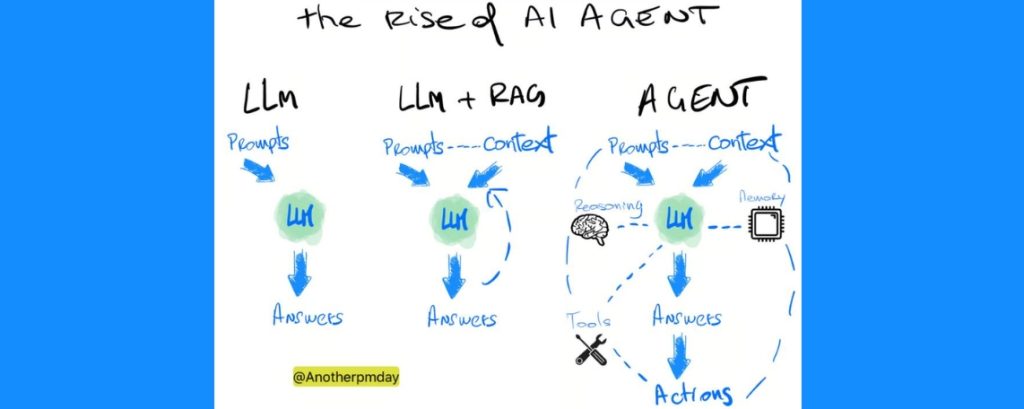
What is an AI Agent, and why has this term shown up in nearly every leadership meeting in Vietnam since late 2024? This article explains it from first principles: what an AI Agent actually is, how it differs from a regular chatbot, and why Generative AI was the turning point that made it more powerful than ever.
Discussions around AI Agents only really took off in Vietnam at the end of 2024 — but globally, McKinsey, Gartner, Forbes, and Harvard Business Review have been tracking this trend since 2023. The problem is that a lot of people still say “AI Agent” without truly understanding what it means. This is the first article in a series designed to help you understand it properly, from the basic definition to the technical architecture, so you can confidently discuss and apply AI Agents in your own business.
Key takeaways
- AI Agents aren’t an entirely new technology — they’re an evolution of the information “agents” that have existed for a long time (call centers, chatbots), now upgraded with real AI capability instead of a hard-coded script.
- The explosion of Generative AI (Foundation AI) since ChatGPT launched has lowered the technical barrier, so integrating AI into a business application no longer requires the thousands of hours of data training that traditional Machine Learning once demanded.
- A complete AI Agent has 3 layers: the Core (Foundation AI), the Optimization layer (Prompt Engineering, RAG, Fine-tuning), and the Interface — understanding these three layers helps a business know exactly where it’s investing.
- AI Agents still have real limits: hallucination, outdated data, and gaps in domain-specific knowledge — which is exactly why Gartner forecasts nearly half of agentic AI projects will be scrapped before 2027 if businesses don’t get the Optimization layer right.
1.What Is an AI Agent? The Simplest Definition
“What is an AI Agent” is a question that usually gets a more complicated answer than it needs. At its core, an AI Agent is a software system that acts as an information-processing assistant, equipped with genuine artificial intelligence capability to understand natural language, reason over data, and respond appropriately to a specific context — instead of just running through a pre-programmed script.
The easiest way to understand this is to split it into two parts: Agent and AI. “Agent” isn’t new — it’s simply a “person” or a system that acts as an information assistant. “AI” is the part that decides whether that assistant genuinely “understands” or is just following a fixed process. Put the two together, and you get the full definition of an AI Agent.
2.What Is an Agent? Humans, Chatbots, and the Line to AI Agents
Broadly speaking, an agent is an information-processing assistant — human or machine.
- Human agents: call center representatives who help answer questions, or handle tasks like booking flights and hotels.
- Machine agents: a chatbot that follows a pre-programmed script also counts as an agent — but not yet an AI Agent, since it only repeats what was set up in advance.
For a system to be called a true AI Agent, it needs to incorporate real AI capability, not just an AI-branded wrapper:
- A voicebot with AI-powered speech recognition that still answers from a fixed script doesn’t fully qualify as a complete AI Agent.
- Virtual assistants like Siri, Alexa, and Google Assistant are early versions of AI Agents — they recognize speech, analyze the query, personalize the response, and surface information relevant to the context.
3.Why AI Agents Exploded Alongside Generative AI
The arrival of Generative AI (also called Foundation AI) is the turning point that let AI Agents leap far beyond the previous generation of virtual assistants. But to understand why that turning point matters, it helps to look back at the role Machine Learning played — the foundation of AI before ChatGPT existed.
4.The Role of Machine Learning Before ChatGPT
Before ChatGPT existed, conversations about AI were mostly about Machine Learning. Building an AI system the traditional way required an expensive training process, often called building a “training dataset.”
For example, training an AI to recognize a picture of a fried egg required manually labeling thousands of images. That process demanded significant investment in:
- Computing power
- Dedicated machine learning engineers
- Large-scale labeled datasets
- Time and budget for continuous tuning and upgrades
In other words, only businesses with substantial resources could afford to “build their own” AI this way — which is exactly why AI stayed out of reach for most companies for years.
5.AI Keeps Getting More Accessible — From Pre-trained Models to AIaaS
The rise of ChatGPT and other generative AI models completely changed how businesses access AI:
- There’s no longer a need to train data from scratch, since pre-trained models are already available and ready to use.
- AI models are now trained on massive datasets, delivering far better accuracy and flexibility than the specialized models that came before.
- AI as a Service (AIaaS) has become the mainstream approach, letting developers with only basic programming knowledge integrate AI into an application quickly.
6.The 3-Layer Architecture of an AI Agent: Core, Optimization, and Interface
To understand how an AI Agent actually works, picture it as three main layers — each with a distinct role that can’t substitute for the others.
The Core (Foundation AI)
This is the core AI model, trained on massive amounts of data — for example, ChatGPT (OpenAI) or Gemini (Google). This layer determines the system’s underlying language and reasoning ability.
The Optimization Layer
This includes techniques like Prompt Engineering, RAG (Retrieval-Augmented Generation), and Fine-tuning, which tailor the foundation model’s responses to a business’s specific needs — this is exactly where a “generic” AI Agent becomes an assistant that truly understands your company’s context.
The Interface (User Interaction Layer)
This is the visible part users actually see and interact with — chatbots and voicebots — communicating through text, voice, images, music, or video.
7.Real Challenges of AI Agents Businesses Need to Know
Despite major progress, AI Agents still have real limitations businesses need to understand before deploying one:
- Hallucination: AI-generated responses can sometimes be inaccurate, yet presented with the same confidence as fact.
- Lack of real-time data: AI models typically rely on data they were trained on, so they may not reflect the latest information.
- Limited domain-specific knowledge: AI models may not know detailed or proprietary business information unless specifically trained on it.
This is exactly why AI engineers apply prompt engineering, RAG, and fine-tuning to address these limits and make AI Agents more relevant and trustworthy for a specific business problem. It’s also precisely because many businesses skip this step that Gartner forecasts more than 40% of agentic AI projects will be scrapped before 2027.
8.What’s Next? Prompt Engineering, RAG, and Fine-Tuning (Part 2)
In the next article of this series, we’ll dive into Prompt Engineering, RAG, and Fine-Tuning — the three most important techniques in the Optimization layer, which determine whether an AI Agent is actually effective for a specific business application. This is the part most businesses miss when they first start with AI Agents, and it’s also what separates a “fun” AI Agent from one that creates real value.
Want to apply AI Agents the right way in your B2B sales process?
OplaCRM is the proactive CRM platform for B2B sales teams in Vietnam — where customer data, pipeline, and interaction history are already organized and ready for the AI Agent layers of tomorrow.
Frequently Asked Questions
 What is an AI Agent?+
An AI Agent is a software system that combines the role of an “agent” (an assistant that processes information and performs tasks) with genuine artificial intelligence capability — meaning it can understand natural language, reason over data, and respond appropriately to context, instead of just following a pre-programmed script.
How is an AI Agent different from a regular chatbot?+
A regular chatbot follows a pre-programmed conversation flow (if the customer says A, reply with B). An AI Agent uses a foundation AI model (like GPT or Gemini) to understand what the user actually wants, handle questions it was never explicitly programmed for, and personalize its response to real context.
Are Generative AI and AI Agent the same thing?+
Not exactly. Generative AI (also called Foundation AI) is the underlying model layer that generates content — text, images, voice. An AI Agent is a system built on top of that model layer, adding an optimization layer (prompt engineering, RAG, fine-tuning) and an interface layer to create an assistant that can interact with users and carry out specific tasks for a business.
What does the 3-layer architecture of an AI Agent consist of?+
The three layers are: the Core (Foundation AI) — the underlying AI model such as GPT or Gemini; the Optimization Layer — Prompt Engineering, RAG, and Fine-tuning techniques that tailor responses to specific needs; and the Interface Layer — the part users actually see and interact with, such as a chatbot or voicebot.
Why do AI Agents sometimes give wrong answers (hallucination)?+
Hallucination happens when an AI Agent generates inaccurate information but presents it with the same confidence as a fact. The root cause is that the AI model predicts words based on statistical probability from its training data, not by looking up ground truth the way a human would. This is exactly why techniques like RAG and fine-tuning matter.
What does a business need to deploy an AI Agent effectively?+
Beyond picking the right foundation AI model, a business needs to invest in the optimization layer — Prompt Engineering, RAG, and Fine-tuning — so the AI Agent responds accurately using the company’s own data and context. That’s exactly what Part 2 of this series covers in detail.