
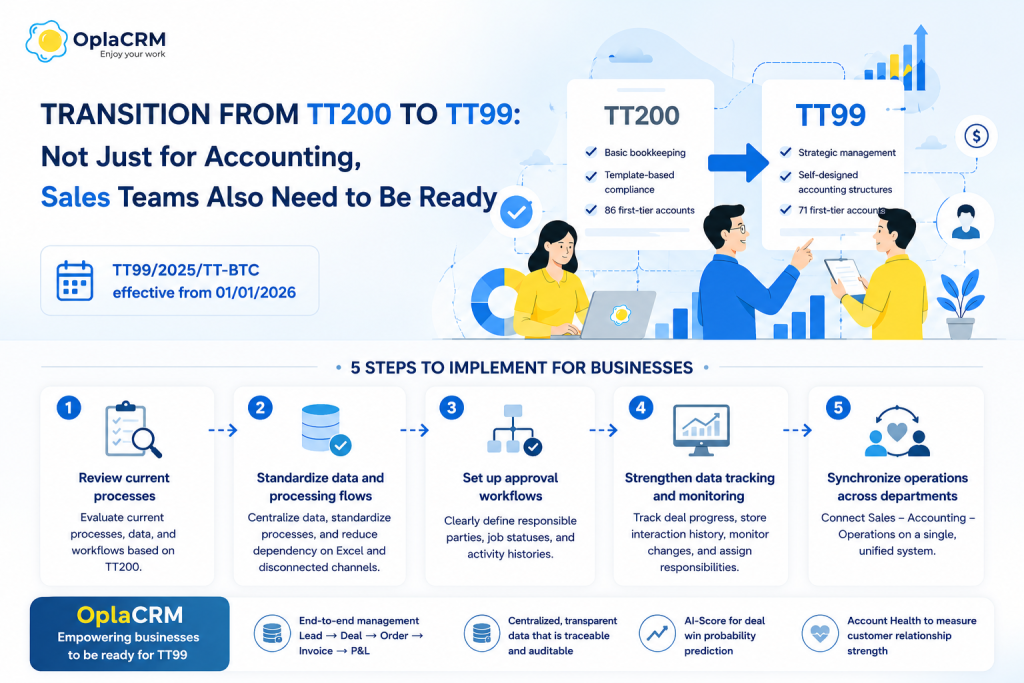
To transition from TT200 to TT99 (effective from January 1, 2026), businesses need to complete five key steps: review current operational processes, standardize centralized data, establish approval workflows, strengthen data tracking capabilities, and synchronize operations seamlessly from Sales to Accounting.
On October 27, 2025, the Ministry of Finance officially issued Circular 99/2025/TT-BTC — fully replacing Circular 200/2014/TT-BTC, which had been in effect for more than 10 years.
This is not simply about changing templates or updating account codes. TT99 fundamentally shifts the mindset: from “standardized compliance” to “self-designed accounting structures,” and from basic bookkeeping to strategic management — and that impacts Sales teams, not just Accounting departments.
So how does this relate to Sales teams?
In many ways. TT99 directly affects revenue recognition, order management, quotations, and invoicing — all of which are closely tied to the daily sales pipeline. If Sales teams continue working with fragmented data, unclear approval flows, and poor traceability, businesses will still face significant risks during the transition, no matter how prepared the Accounting department may be.
Below are five steps to help businesses transition smoothly, with a focus on operational optimization rather than purely accounting adjustments.
Step 1: Are Your Current Operational Processes Ready?
Before starting the transition, businesses should conduct a “health check” on their current operational processes. Specifically, identify which processes still rely on manual work, where customer data is currently stored (Excel, email, Zalo, or CRM), who approves quotations and orders, and which departments are involved from lead generation to deal closure.
This step helps businesses answer one critical question: “Are we truly operating based on standardized processes, or are we only changing paperwork?”
Sales teams are often where data fragmentation is most severe. Customer information is scattered across personal notes, Zalo messages, and isolated quotation files. When TT99 requires revenue to be recognized based on the satisfaction of performance obligations rather than invoice issuance timing, this fragmentation becomes a real business risk.
Step 2: Fragmented Data — How Can It Be Standardized?
One of the most common issues today is fragmented data, files processed across multiple channels, and uncertainty about which version is the latest. Quotations are sent via email, orders are confirmed through Zalo, and contracts are stored on personal Google Drives — everyone works differently.
Businesses should standardize where data is stored, unify workflows from lead to deal, and reduce dependency on Excel and disconnected communication channels.
When all customer information, interaction history, quotations, and orders are managed centrally on a CRM platform, reconciling data between Sales and Accounting becomes significantly easier — especially as TT99 requires greater transparency and stronger internal controls.
Step 3: Who Approves What, and When?
When sales processes involve multiple departments — Sales creates quotations, managers approve discounts, Accounting confirms orders, and warehouses dispatch goods — the absence of workflows leads to delays, errors, lack of transparency, and audit difficulties.
TT99 emphasizes that businesses must establish internal governance policies with clearly defined authority, responsibilities, and obligations across departments. This means every process step must have a designated owner, clear work statuses, and recorded activity histories.
For Sales teams, approval workflows help shorten deal-closing time. Instead of waiting 2–3 days for discount approval emails, a CRM system with automated workflows can route requests to the right person at the right time.
Step 4: Improving Sales Data Traceability
This is the step many businesses overlook, yet it often becomes the most painful issue once TT99 takes effect. TT99 moves toward a “preventive control” model instead of a “post-inspection” model — meaning businesses must be able to prove who did what, when, and how data changed.
Consider this situation: a Sales team closes a six-month service implementation contract in December, but under TT99, revenue can only be recognized once the performance obligation is satisfied — not when the invoice is issued. Without a system to track deal progress, Accounting cannot determine the correct timing for revenue recognition. The result? Misstated financial statements, audit concerns, and potential tax penalties.
Businesses should prioritize the ability to track sales opportunity progress, maintain customer interaction histories, control all changes to quotations and orders, and clearly document each person’s responsibility in every deal. A strong CRM platform provides complete visibility into a deal’s journey — from lead acquisition to won or lost status — including every note, change, and responsible user.
Step 5: Are Sales and Accounting “Speaking the Same Language”?
If Step 4 focuses on data traceability within the Sales team, Step 5 is about connecting data across departments — especially Sales, Accounting, and Procurement.
TT99 changes revenue recognition from invoice issuance timing to the satisfaction of performance obligations and the transfer of control over goods/services. This requires Sales and Accounting to share the same data source — and the same understanding of when a deal is legally considered “completed.”
If Sales uses a CRM, Accounting uses separate accounting software, and Procurement manages everything in Excel — with no communication between systems — synchronization becomes nearly impossible. The earlier businesses integrate these systems (or adopt a CRM platform with integrated commercial management modules), the better they can adapt to TT99.
How Is Circular 99/2025/TT-BTC Different from Circular 200/2014/TT-BTC??
The biggest difference lies not in templates, but in mindset. TT200 required all businesses to comply with the same rigid framework. TT99 allows businesses to independently design their chart of accounts, as long as the financial statements present a true and fair view.
Specifically: the chart of accounts has been streamlined from 86 to 71 first-tier accounts, the “Balance Sheet” has been renamed the “Statement of Financial Position,” businesses are allowed to customize account codes and structures according to operational characteristics, and revenue recognition is now based on the satisfaction of performance obligations instead of invoice issuance timing.
These changes are designed to align Vietnam’s accounting practices with international accounting standards (IFRS) and require stronger systems and internal controls.
How Does OplaCRM Help Businesses Prepare for TT99?
OplaCRM is built with an end-to-end architecture covering Lead Management, Account Management, Opportunity Management, and Commercial Management — including quotation management, order management, invoice management, and profit-and-loss (P&L) management.
This means sales data is no longer fragmented, but connected within a single unified system. When the Accounting department needs to trace the origin of revenue, OplaCRM provides a complete history: from lead source and interaction steps to quotations sent and finalized orders.
With AI-Score for predicting deal win probability and Account Health for measuring customer relationship strength, OplaCRM not only helps Sales teams sell more effectively, but also provides high-quality operational data across the entire organization — ready for the new TT99 era.
👉 Register for an OplaCRM demo to see how the system synchronizes Sales and Accounting operations.
Frequently Asked Questions About TT99 and Business Operations.
Has TT99 completely replaced TT200?
Yes. Circular 99/2025/TT-BTC officially and fully replaces Circular 200/2014/TT-BTC, effective from January 1, 2026, and applicable to financial years beginning on or after this date.
What should businesses prepare for when transitioning from TT200 to TT99?
Businesses should review current operational processes, standardize data, establish clear approval workflows, improve data tracking capabilities, and synchronize operational systems across departments (especially Sales and Accounting). Updating accounting software and CRM systems before the effective date is also highly recommended.
Will businesses still using TT200 after January 1, 2026 face penalties?
TT99 becomes mandatory from January 1, 2026. Businesses that fail to transition in time may face risks related to non-compliant financial statements, which could affect audits and tax obligations.
Which departments are affected by TT99?
Not only Accounting. TT99 impacts operations, finance, Sales, Procurement, and internal data governance. In particular, the new revenue recognition approach requires close coordination between Sales and Accounting.
Why should Sales teams care about TT99?
TT99 changes revenue recognition from invoice issuance timing to the satisfaction of performance obligations and transfer of control. This requires sales data — including pipelines, orders, and quotations — to be accurate, transparent, and traceable, all of which are capabilities a strong CRM system should provide.
Is Your Business Ready for TT99?
👉 Explore how OplaCRM helps businesses synchronize Sales, Accounting, and operations more effectively during the TT99 transition period.
This article is part of the OplaCRM Blog — #1 B2B Sales CRM in Vietnam. Enjoy your work.